Agent Systems · R&D Demos
Multi-Agent Content Orchestration
Exploring deterministic agent handoffs and human-in-the-loop control with LangGraph
Juan Iturbe •
Exploring deterministic agent handoffs and human-in-the-loop control with LangGraph
Research & Demo
This is an experimental LangGraph implementation built to explore agent orchestration patterns such as stateful workflows, deterministic handoffs, evaluation gates, and human-in-the-loop control.
ReAct-swarm is a stateful multi-agent pipeline where specialized agents collaborate through explicit state transitions rather than ad-hoc prompt chaining.
The goal of the project is to answer a practical question:
What does an agent system need once you move past single-prompt demos?
The system focuses on control, predictability, and recovery—the parts that tend to break first in real agent workflows.
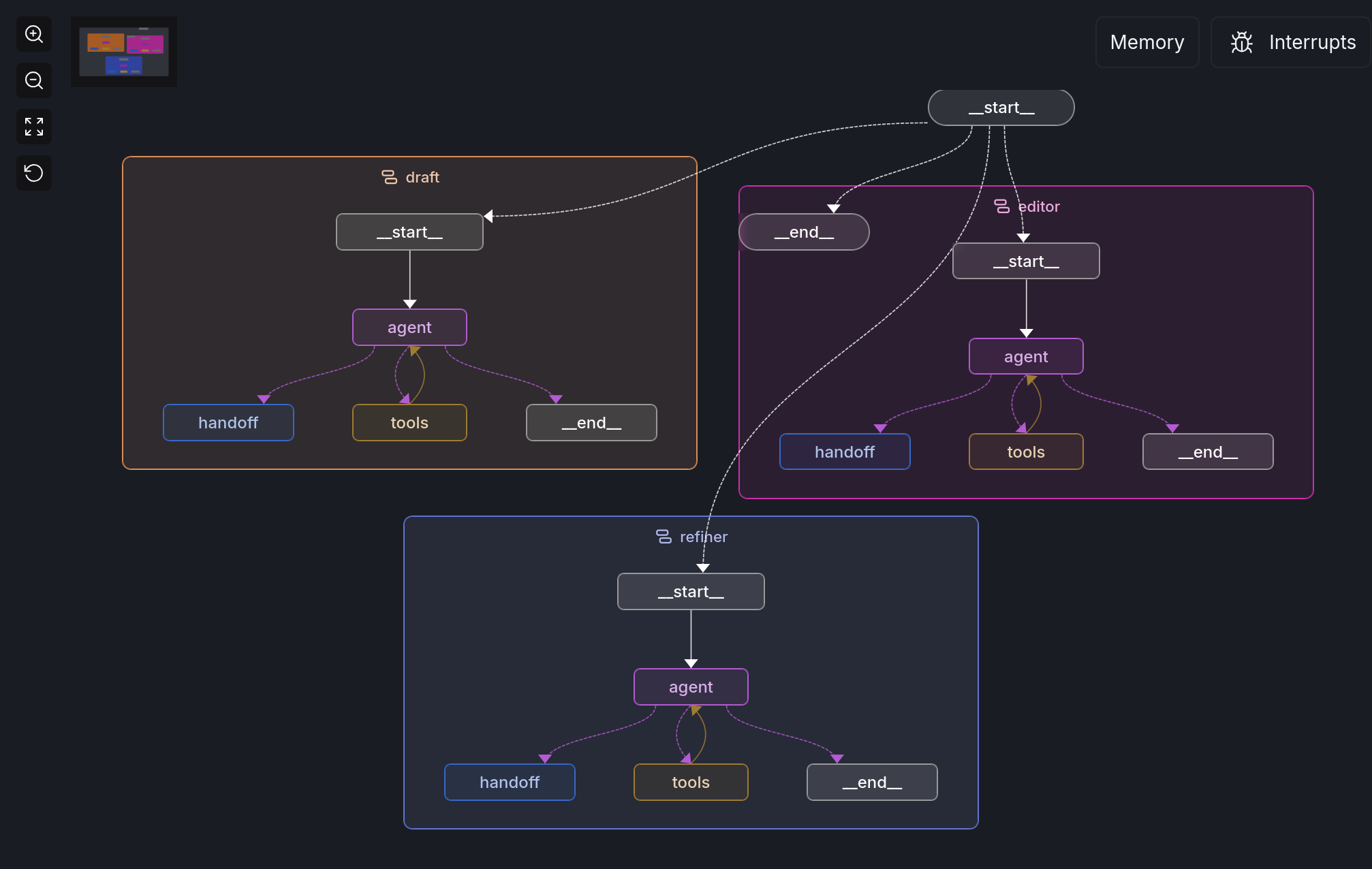
Watch how the system orchestrates multiple agents through deterministic transitions.
The workflow is orchestrated using LangGraph as a deterministic state machine.
Agents:
Key constraints:
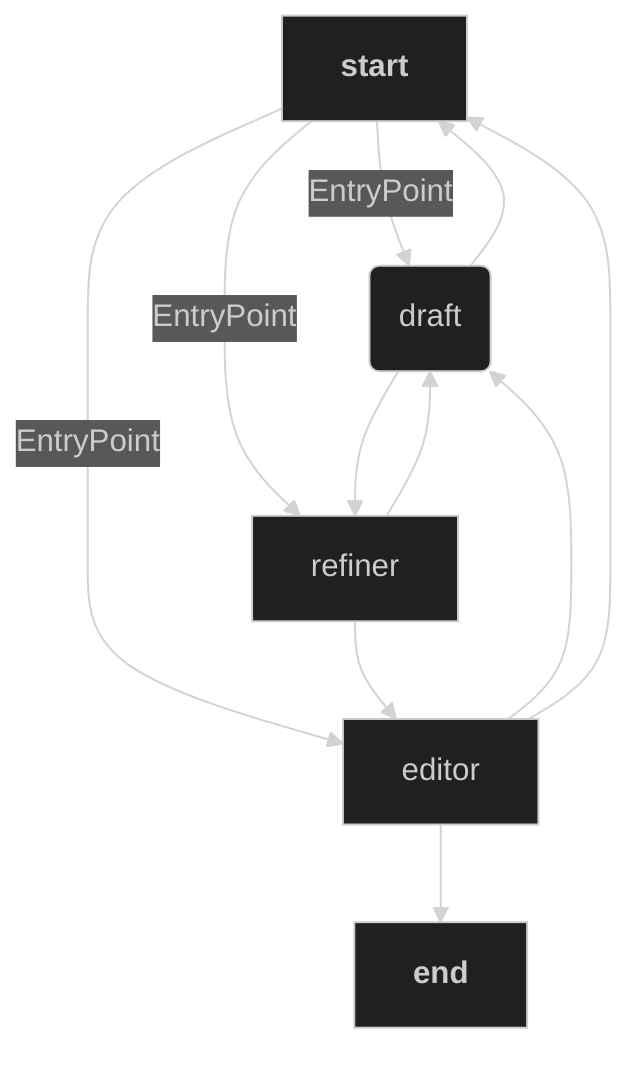
Draft
  → (human approval)
Refiner
  → (human approval)
Editor (rubric-based evaluation)
  → approve → publish
  → reject → back to Draft
The graph allows controlled loops (Editor → Draft) without losing state.
Agents operate within a shared state model rather than isolated calls.
Each transition is intentional and traceable. There are no implicit agent jumps or hidden autonomy.
Approval gates allow intervention without breaking the workflow or resetting context.
The Editor agent scores output against a fixed 7-point rubric. Clear thresholds determine whether content advances or loops back.
Agent state is checkpointed in PostgreSQL, enabling:
Relevant areas:
src/graph.ts — orchestration logicsrc/state.ts — shared state modelsrc/agents/ — agent definitionsdb/ — persistence and configuration